If you have shipped software, you know the SDLC: requirements, design, build, test, deploy. AI-DLC (the AI-Driven Development Life Cycle) keeps those stages. What changes is who does the work: humans and AI agents share it, end to end.
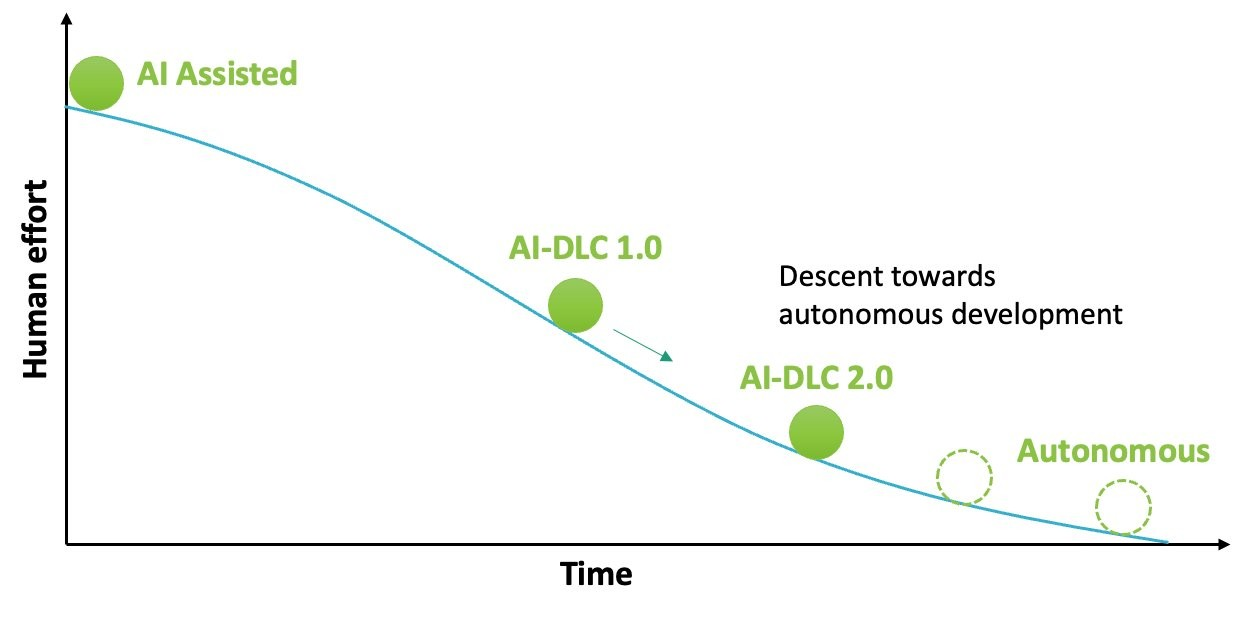
Version 1 ran the lifecycle as a sequence of stages with a human checking in at every step. It proved the idea works. Version 2 keeps the method but rebuilds the workflow layer so the amount of human babysitting can shrink over time.
Same lifecycle
Requirements, design, build, test and deploy stay. You are not learning a new process from scratch.
Shared work
AI agents do much of the generating. Humans clarify, judge and approve where it matters.
Autonomy grows with checks
Every rule a machine can verify is one less thing a person has to look at. Version 2 is built around that idea.
| AI-DLC 1.0 | AI-DLC 2.0 | |
|---|---|---|
| Shape | A fixed sequence of stages | Composable building blocks (Skills) you arrange yourself |
| Human role | In the loop at every step | Involved when ambiguity or real judgement needs a person |
| Quality control | Mostly human review and steering rules | Machine-checkable verification that keeps expanding |
| Direction | Prove the value | March step by step towards autonomous delivery |
Why was it redesigned?
1. Customers wanted smaller building blocks
Teams did not want one boxed process. They wanted composable pieces they could fit to their own delivery flow. Think Lego bricks instead of a pre-built model.
2. Agent platforms grew up
Skills package a discrete capability. Multi-agent runtimes model a team of specialists. That makes fine-grained work and its checks expressible natively, not only through steering rules.
Version 2 also uses deterministic lifecycle hooks (for halting and audit, like a smoke detector plus a flight recorder) and MCP, the Model Context Protocol (a universal adapter for delivering tools and context to any agent).
Ask of any task your team does: could a program check whether it was done right? Those tasks are the first ones AI can take over safely.
Want the original wording? Read Section 1 of the specification.